Kokura Castle
A castle in Kitakyushu, Fukuoka, built by Hosokawa Tadaoki in 1602 and famous for its unique 'karasumata' roof overhang on the top story. The reconstructed five-story keep and surrounding park are the centerpiece of the Kokura historic district.
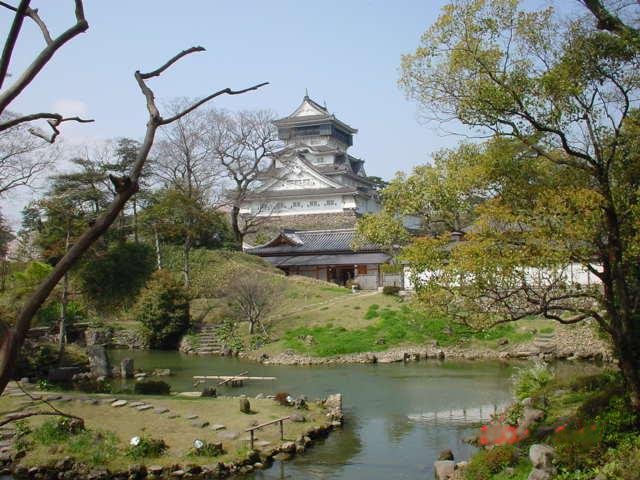
| Japanese Name | 小倉城 |
|---|---|
| Prefecture | Fukuoka Prefecture (福岡県) |
| Region | Kyushu (九州) |
| Castle Type | Flatland Castle |
| Year Built | 1602 |
| Designation | 続100名城 |
| Coordinates | 33.8833, 130.875 |
Kokura Castle in Kitakyushu stands as a notable example of early Edo period flatland castle architecture, built in 1602 by Hosokawa Tadaoki, a prominent daimyo and cultural figure of the age. The castle became a centerpiece of the Kokura region and is recognized among Japan's continued 100 famous castles for its architectural distinctions and historical importance.
Hostokawa Tadaoki, who had already established himself as both a military commander and patron of the arts, designed this fortress during a period of relative peace following the consolidation of Tokugawa rule. The castle's construction reflected both practical defensive needs and aesthetic considerations that characterized the early Edo period. Its location in a bustling commercial and administrative center made it a symbol of Tokugawa authority and stability in northern Kyushu.
The castle's most distinctive feature is the karasumata roof overhang on the top story of the keep. This architectural element, which resembles a crow's crotch in its angular form, was both decorative and functional, providing additional structural support while creating a visually striking appearance. The five-story reconstructed keep maintains this distinctive design, making it recognizable even among other restored castle towers. The surrounding park and historic district have been developed to preserve the castle's context within the community.
The reconstructed keep functions as a museum and cultural center, allowing visitors to explore the castle's history and view artifacts from the Edo period. The site remains central to Kitakyushu's identity, and the castle grounds offer both historical education and pleasant recreational space for the public. The architectural style and urban setting make this castle an important reference point for understanding how castles functioned as administrative and cultural hubs.
Kokura Castle is recognized as one of Japan's second 100 castles as designated by the Japan Castle Foundation, a distinction that highlights its historical and architectural importance among the hundreds of castle sites across the country. As a flatland castle, its design reflects the defensive priorities and construction techniques of its era, with origins dating to 1602. Visitors traveling to Fukuoka Prefecture can explore the site alongside other regional historical attractions.
On the Ground
| Address | Muromachi 1-chome, Senbamachi, Kokura-Kita Ward, Kitakyushu, Fukuoka Prefecture, 802-0007, Japan |
|---|---|
| Car parking | 41 car parks within 1.5 km — nearest about 245 m away |
| Public toilets | 12 public toilets within 1.5 km — nearest about 102 m away |
Car parks and toilets are counted from OpenStreetMap within 1.5 km of the castle coordinates, as recorded on 2026-08-15. They are not necessarily run by the castle, and OpenStreetMap does not record every facility — “none recorded” does not mean there are none.
Castle Hopping from Here
| Castle | Distance |
|---|---|
| Chofu Castle 長府城 | 12.4 km |
Distances are straight-line between castle coordinates, not travel distance. Only castles within 30 km are listed.
Is It Original?
| Original keep still standing? | No — this castle is not among the twelve in Japan whose keep survives from the pre-modern period. Any tower here is a later reconstruction or the site is a ruin. |
|---|---|
| Classification on this site | Reconstructed Castle |
| Nationally designated properties recorded here | — (none found in the database) — please check with the castle directly |
The count of twelve surviving keeps is stated independently by the official sites of Matsue, Maruoka, Matsuyama and Bitchu Matsuyama (checked 2026-09-04). Each of the twelve carries its own source on its own page. The classification line below it is this site's own grouping, not an official designation. The designated properties below it come from the Agency for Cultural Affairs national database of designated cultural properties (国指定文化財等データベース), retrieved 2026-08-13. A missing line means no entry was found in that database — not that the property is undesignated.
Getting There
| Nearest station | Tanga Station (旦過駅) — 0.6 km in a straight line |
|---|---|
| Largest station nearby | Kokura Station — 0.7 km in a straight line |
| Daily passengers at that station (2019) | 71,270 |
Station distances are straight-line, measured from the castle coordinates. Passenger counts: National Land Numerical Information (MLIT), FY2019.
Location
View larger map — © OpenStreetMap contributors
Sources and What a Blank Means
Data on this page comes from OpenStreetMap, Wikimedia Commons, the Agency for Cultural Affairs national database of designated cultural properties and the National Land Numerical Information service (MLIT). Checked 2026-08-22.
A blank or missing line means we found no record in those sources — not that the castle lacks the thing. Admission fees, opening hours and access change without notice; please confirm with the official site before travelling.