Matsumae Castle
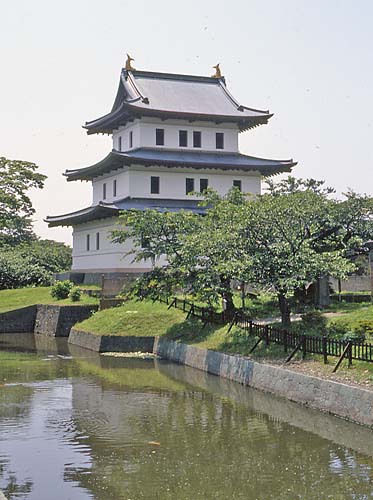
The northernmost castle in Japan and the only one in Hokkaido. Built in 1849 by the Matsumae clan, it guarded against Russian expansion and is surrounded by hundreds of cherry trees.
| Japanese Name | 松前城 |
|---|---|
| Prefecture | Hokkaido (北海道) |
| Region | Hokkaido (北海道) |
| Castle Type | Flatland Castle |
| Year Built | 1849 |
| Designation | 100名城 |
| Coordinates | 41.435, 140.1198 |
Matsumae Castle holds the distinction of being Japan's northernmost castle and the only castle constructed in Hokkaido during the feudal era. Built in 1849 by the Matsumae clan near the southwestern tip of Hokkaido, this structure represented both the clan's political authority and Japan's strategic interests in defending against Russian expansion during a period of heightened international tension.
The Matsumae clan had ruled the Matsumae domain for centuries, but construction of this formal castle came relatively late in the feudal period. The decision to build reflected growing concerns about foreign threats and the clan's desire to strengthen their defensive position. Built in the flatland style typical of the era, the castle incorporated traditional Japanese architectural elements despite its relatively late construction date.
The castle complex features a three-story tower and interconnected defensive structures surrounded by sturdy wooden palisades. Though the original structure was destroyed during the Meiji Restoration, the current main tower is a modern reconstruction completed in 1961 based on historical records and archaeological evidence. The site is renowned for the hundreds of cherry trees planted throughout the castle grounds, creating a spectacular display each spring that attracts visitors from across Japan.
The castle remains accessible to tourists throughout the year, with the museum inside the main tower displaying artifacts related to the Matsumae clan and Hokkaido's history. The combination of historical architecture and natural beauty makes it one of Hokkaido's most visited cultural sites, particularly during cherry blossom season.
Matsumae Castle is recognized as one of Japan's top 100 castles as designated by the Japan Castle Foundation, a distinction that highlights its historical and architectural importance among the hundreds of castle sites across the country. As a flatland castle, its design reflects the defensive priorities and construction techniques of its era, with origins dating to 1849. Visitors traveling to Hokkaido can explore the site alongside other regional historical attractions.
On the Ground
| Address | Tsukishima, Matsumae, Matsumae County, Oshima Subprefecture, Hokkaido Prefecture, Hokkaido Region, 049-1517, Japan |
|---|---|
| Car parking | 5 car parks within 1.5 km — nearest about 715 m away |
| Public toilets | 1 public toilet within 1.5 km — nearest about 1426 m away |
Car parks and toilets are counted from OpenStreetMap within 1.5 km of the castle coordinates, as recorded on 2026-08-15. They are not necessarily run by the castle, and OpenStreetMap does not record every facility — “none recorded” does not mean there are none.
Is It Original?
| Original keep still standing? | No — this castle is not among the twelve in Japan whose keep survives from the pre-modern period. Any tower here is a later reconstruction or the site is a ruin. |
|---|---|
| Classification on this site | Reconstructed Castle |
| Nationally designated properties recorded here | — (none found in the database) — please check with the castle directly |
The count of twelve surviving keeps is stated independently by the official sites of Matsue, Maruoka, Matsuyama and Bitchu Matsuyama (checked 2026-09-04). Each of the twelve carries its own source on its own page. The classification line below it is this site's own grouping, not an official designation. The designated properties below it come from the Agency for Cultural Affairs national database of designated cultural properties (国指定文化財等データベース), retrieved 2026-08-13. A missing line means no entry was found in that database — not that the property is undesignated.
Location
View larger map — © OpenStreetMap contributors
Sources and What a Blank Means
Data on this page comes from OpenStreetMap, Wikimedia Commons and the Agency for Cultural Affairs national database of designated cultural properties. Checked 2026-08-22.
A blank or missing line means we found no record in those sources — not that the castle lacks the thing. Admission fees, opening hours and access change without notice; please confirm with the official site before travelling.