Nagoya Castle Karatsu
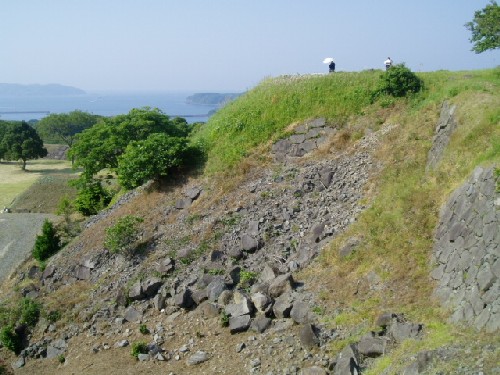
Built in just five months in 1592 by Toyotomi Hideyoshi as the staging base for his invasions of Korea. Over 130,000 troops assembled here; the castle and its 100+ daimyo residences created Japan's second-largest castle town. The massive stone walls survive in excellent condition.
| Japanese Name | 名護屋城 |
|---|---|
| Prefecture | Saga Prefecture (佐賀県) |
| Region | Kyushu (九州) |
| Castle Type | Hill Castle |
| Year Built | 1592 |
| Designation | 100名城 |
| Coordinates | 33.5278, 129.8556 |
Nagoya Castle in Karatsu stands as a remarkable monument to one of Japan's most ambitious military campaigns, built in just five months during 1592 by Toyotomi Hideyoshi as the staging base for his invasions of Korea. This hilltop fortress briefly served as the headquarters for one of the largest military mobilizations in medieval history and remains one of Japan's 100 famous castles. Its exceptional historical context and surviving structures make it significant for understanding this turbulent period.
The castle was constructed with remarkable speed as Hideyoshi gathered and organized an enormous military force for his Korean campaign. At its height, over 130,000 troops assembled at the site, making it a temporary hub of unprecedented scale. Beyond the main castle, Hideyoshi directed construction of over 100 residences for daimyo and their retinues, creating Japan's second-largest castle town. This vast assemblage of buildings and personnel reflected Hideyoshi's remaining power and his determination to project Japanese military strength across the straits to Korea.
Despite its brief period of intensive use, the castle's physical infrastructure was built to endure. The massive stone walls constructed at the site remain in excellent condition even today, testimony to the engineering standards applied to the project. The walls enclose substantial areas and are among the largest and most impressive surviving from this period, demonstrating the resources devoted to the fortress.
Visitors to the site can observe the extensive stone walls and explore the archaeological remains that reveal the castle's scale and importance. A museum and information center at the location provide historical context for the fortress and its role in Hideyoshi's ambitions. The site's remote hilltop location in Karatsu, while requiring some effort to reach, rewards visitors with panoramic views and a tangible sense of the military grandeur that characterized late sixteenth-century Japan.
Nagoya Castle Karatsu is recognized as one of Japan's top 100 castles as designated by the Japan Castle Foundation, a distinction that highlights its historical and architectural importance among the hundreds of castle sites across the country. Its design reflects the defensive priorities and construction techniques of the feudal period, with origins dating to 1592. Visitors traveling to Saga Prefecture can explore the site alongside other regional historical attractions.
On the Ground
| Address | Chinzeimachi-Nagoya, Karatsu, Saga Prefecture, 847-0401, Japan |
|---|---|
| Car parking | 7 car parks within 1.5 km — nearest about 980 m away |
| Public toilets | 1 public toilet within 1.5 km — nearest about 1187 m away |
Car parks and toilets are counted from OpenStreetMap within 1.5 km of the castle coordinates, as recorded on 2026-08-15. They are not necessarily run by the castle, and OpenStreetMap does not record every facility — “none recorded” does not mean there are none.
Castle Hopping from Here
| Castle | Distance |
|---|---|
| Karatsu Castle 唐津城 | 13.2 km |
Distances are straight-line between castle coordinates, not travel distance. Only castles within 30 km are listed.
Is It Original?
| Original keep still standing? | No — this castle is not among the twelve in Japan whose keep survives from the pre-modern period. Any tower here is a later reconstruction or the site is a ruin. |
|---|---|
| Classification on this site | Historic Ruins |
| Nationally designated properties recorded here | 1 |
| Recorded property names (Japanese) | 名護屋城跡並陣跡 |
The count of twelve surviving keeps is stated independently by the official sites of Matsue, Maruoka, Matsuyama and Bitchu Matsuyama (checked 2026-09-04). Each of the twelve carries its own source on its own page. The classification line below it is this site's own grouping, not an official designation. The designated properties below it come from the Agency for Cultural Affairs national database of designated cultural properties (国指定文化財等データベース), retrieved 2026-08-13. Official record. A missing line means no entry was found in that database — not that the property is undesignated.
Location
View larger map — © OpenStreetMap contributors
Sources and What a Blank Means
Data on this page comes from OpenStreetMap, Wikimedia Commons and the Agency for Cultural Affairs national database of designated cultural properties. Checked 2026-08-22.
A blank or missing line means we found no record in those sources — not that the castle lacks the thing. Admission fees, opening hours and access change without notice; please confirm with the official site before travelling.