Nakijin Castle
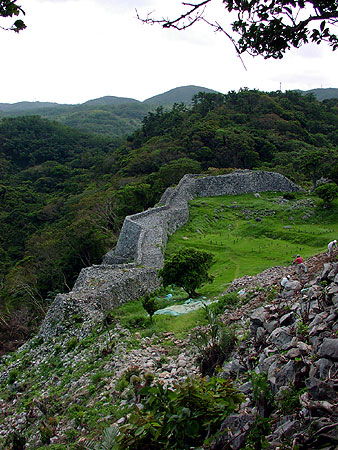
A UNESCO World Heritage Gusuku (Ryukyuan castle) on a high ridge in northern Okinawa, the seat of the 'Northern Mountain' king before Ryukyu was unified. The sinuous layered limestone walls, up to 8 meters high, are the longest of any Gusuku and frame breathtaking views of the East China Sea.
| Japanese Name | 今帰仁城 |
|---|---|
| Prefecture | Okinawa Prefecture (沖縄県) |
| Region | Kyushu (九州) |
| Castle Type | Gusuku |
| Year Built | 13th c. |
| Designation | 100名城 |
| Coordinates | 26.6942, 127.9586 |
Nakijin Castle represents a UNESCO World Heritage Gusuku, the distinctive castle type of the Ryukyuan kingdom, located on a high ridge in northern Okinawa overlooking the East China Sea. Built in the 13th century, it served as the seat of the 'Northern Mountain' ruler before the unified Ryukyuan Kingdom emerged under the Sho dynasty. The castle's significance lies in its role as a major political and military center during the crucial period when Okinawa's regional powers were consolidating control.
The fortress was strategically positioned on its elevated ridge location to control northern Okinawa and monitor maritime approaches. As a Gusuku, it represents the indigenous fortification architecture of the Ryukyuan people, distinct from mainland Japanese castle design. The structure was built using local limestone and evolved through multiple periods of construction and modification as political power shifted across the islands.
The most distinctive feature of this castle is its remarkable system of sinuous layered limestone walls, which extend significantly longer than those of other Gusuku sites and reach heights of up to eight meters. These walls follow the natural contours of the ridge, creating an impressive defensive barrier that showcases sophisticated understanding of both military strategy and landscape integration. The precision stonework demonstrates the advanced construction knowledge of Ryukyuan builders, while the hilltop location offers panoramic views across the surrounding terrain and coastal areas.
The site is open to visitors and accessible year-round, offering hiking paths through the ruins and viewpoints along the ridge. The combination of archaeological remains and natural landscape provides insight into both Gusuku architecture and the geography that shaped Okinawan civilization.
Nakijin Castle is recognized as one of Japan's top 100 castles as designated by the Japan Castle Foundation, a distinction that highlights its historical and architectural importance among the hundreds of castle sites across the country. Its design reflects the defensive priorities and construction techniques of the feudal period, with origins dating to 13th c. Visitors traveling to Okinawa Prefecture can explore the site alongside other regional historical attractions.
On the Ground
| Address | Heshiki, Nakijin, Kunigami, Okinawa Prefecture, 905-0424, Japan |
|---|---|
| Car parking | 2 car parks within 1.5 km — nearest about 1312 m away |
| Public toilets | None recorded within 1.5 km |
Car parks and toilets are counted from OpenStreetMap within 1.5 km of the castle coordinates, as recorded on 2026-08-15. They are not necessarily run by the castle, and OpenStreetMap does not record every facility — “none recorded” does not mean there are none.
Is It Original?
| Original keep still standing? | No — this castle is not among the twelve in Japan whose keep survives from the pre-modern period. Any tower here is a later reconstruction or the site is a ruin. |
|---|---|
| Classification on this site | UNESCO World Heritage |
| Nationally designated properties recorded here | 1 |
| Recorded property names (Japanese) | 今帰仁城跡 附シイナ城跡 |
The count of twelve surviving keeps is stated independently by the official sites of Matsue, Maruoka, Matsuyama and Bitchu Matsuyama (checked 2026-09-04). Each of the twelve carries its own source on its own page. The classification line below it is this site's own grouping, not an official designation. The designated properties below it come from the Agency for Cultural Affairs national database of designated cultural properties (国指定文化財等データベース), retrieved 2026-08-13. Official record. A missing line means no entry was found in that database — not that the property is undesignated.
Location
View larger map — © OpenStreetMap contributors
Sources and What a Blank Means
Data on this page comes from OpenStreetMap, Wikimedia Commons and the Agency for Cultural Affairs national database of designated cultural properties. Checked 2026-08-22.
A blank or missing line means we found no record in those sources — not that the castle lacks the thing. Admission fees, opening hours and access change without notice; please confirm with the official site before travelling.