Zakimi Castle
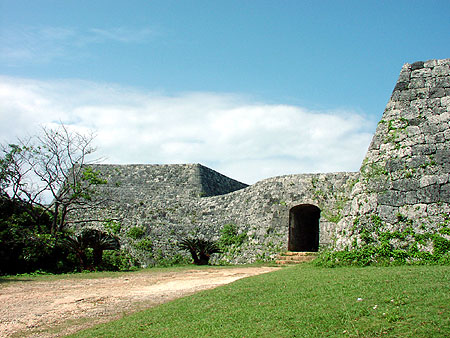
A UNESCO World Heritage Gusuku in Yomitanson, Okinawa, built by the great castle architect Gosamaru in the early 15th century. Its double-layered curved walls feature the first-ever use of arched castle gates (rounded vaulted arch) in Japan.
| Japanese Name | 座喜味城 |
|---|---|
| Prefecture | Okinawa Prefecture (沖縄県) |
| Region | Kyushu (九州) |
| Castle Type | Gusuku |
| Year Built | 15th c. |
| Designation | 続100名城 |
| Coordinates | 26.4333, 127.7167 |
Zakimi Castle stands as a UNESCO World Heritage Gusuku located in Yomitanson, Okinawa, built during the early 15th century by the renowned castle architect Gosamaru. This fortress represents a transitional period in Ryukyuan military architecture, constructed during the complex process of regional consolidation that would eventually lead to unified kingdom rule. The castle's architectural innovations had lasting influence on subsequent fortress construction throughout the Ryukyuan islands.
Gosamaru was recognized as one of the most skilled castle builders of his era, and his work at this site demonstrates sophisticated understanding of defensive design and stone construction. The castle was built at a time when architectural practices were evolving to meet new military needs and reflect advancing construction capabilities. Its strategic location in central Okinawa made it an important administrative and defensive center during its period of active use.
The castle's most notable distinction is its implementation of double-layered curved stone walls that feature the earliest known use of arched gates with rounded vaulted architecture in Japan. This innovation in gateway design, incorporating curved stonework to create barrel-vault passages, represented a significant technological advancement and reflected possible influences from Chinese architectural practices. The arched gates provided both enhanced structural strength and improved defensive capabilities compared to traditional straight-passage designs. The curved walls themselves, built using carefully fitted limestone blocks, demonstrate exceptional masonry skills and remain impressively intact.
The site welcomes visitors throughout the year, with restored structures and interpreted ruins allowing exploration of the fortress layout. The castle's architectural innovations and historical significance make it essential for understanding the development of fortification design in East Asia during the medieval period.
Zakimi Castle is recognized as one of Japan's second 100 castles as designated by the Japan Castle Foundation, a distinction that highlights its historical and architectural importance among the hundreds of castle sites across the country. Its design reflects the defensive priorities and construction techniques of the feudal period, with origins dating to 15th c. Visitors traveling to Okinawa Prefecture can explore the site alongside other regional historical attractions.
The man who built it had just helped take a castle
Zakimi was built by Gosamaru, the aji (lord) of Yomitanzan, a man the village’s official history describes as famous in his own time as a castle builder. He did not start here. He was living at Yamada Gusuku, about four kilometres to the north-east.
Then, in 1416 — some accounts say 1422 — he joined Shō Hashi’s attack on Nakijin, the stronghold of the northern kingdom of Hokuzan. The official account says that immediately afterwards, weighing up the advantage of the ground, he built at Zakimi.
That is an unusual origin for a castle. A man who had just seen a great fortress fall picked new ground and built his own, and what he built is still standing well enough to walk on six hundred years later.
The oldest stone arch on the island
The Okinawa Prefectural Board of Education says the gate here, an arch assembled from cut stone, is thought to be the oldest surviving stone gate on Okinawa Island. Note the wording: not the oldest in Okinawa Prefecture, and not proven — thought to be, on Okinawa Island.
The same source gives the reason the castle exists at all: Gosamaru built it in the first half of the fifteenth century to keep watch on Hokuzan, the kingdom whose castle he had just helped to take.
Small, and precisely measured
The village records the size exactly: the outer wall runs 365 metres around, and the area enclosed is 7,385 square metres — which it calls medium-sized for a castle of the early fifteenth century.
Zakimi is not a big site and does not pretend to be. What it has is the stonework. The walls curve rather than run straight, and they are doubled — an outer and an inner enclosure, each with its own arched gate.
Its legal protection was issued by a country that no longer exists
This is the detail most visitors miss. Zakimi was first protected in 1956, as an Important Cultural Property of the Government of the Ryukyu Islands — the administration that governed Okinawa while it was under American control after the war.
When Okinawa returned to Japan in 1972, the site was designated a National Historic Site under Japanese law. Between 1973 and 1985, with support from the Agency for Cultural Affairs and the prefecture, the site was excavated and the walls repaired.
On 2 December 2000 it was inscribed as one component of Gusuku Sites and Related Properties of the Kingdom of Ryukyu, Japan’s eleventh World Heritage property.
Free, and open whenever you get there
There is no ticket office and no closing day. The village’s own page says simply that you may enter freely. The adjoining Yuntanza Museum is the paid part, at ¥500 for adults, and it is where the excavated finds and the explanation of the site are kept.
If you are planning a day around it: no gate means no opening hour to work around, which is rarer than it sounds among Japan’s World Heritage sites.
The other eight
Zakimi is one of nine components in the inscription. The others are Shuri Castle Site, the Sonohyan-utaki Stone Gate, Tamaudun, Shikinaen, Nakijin Castle Site — the castle Gosamaru helped attack — Katsuren Castle Site, Nakagusuku Castle Site, and Sefa-utaki.
Three of them belong to one connected story, and the prefecture’s own descriptions join it up. Nakijin is the castle Gosamaru helped attack. Nakagusuku, it says, was built by Gosamaru, lord of Zakimi, on the king’s orders, to hold in check Amawari, the lord of Katsuren. And Katsuren, it says, was where Amawari lived — the aji who went on to attack Shuri for the throne, and was defeated and destroyed.
So four of the nine World Heritage sites are stops in a single fifteenth-century quarrel, and Zakimi is where its builder started.
Details checked on the Yomitan Village and Okinawa Prefecture official sites on 13 September 2026.
On the Ground
| Address | Zampa Road, Uza, Yomitan, Nakagami, Okinawa Prefecture, 904-0394, Japan |
|---|---|
| Car parking | 58 car parks within 1.5 km — nearest about 146 m away |
| Public toilets | 2 public toilets within 1.5 km — nearest about 687 m away |
Car parks and toilets are counted from OpenStreetMap within 1.5 km of the castle coordinates, as recorded on 2026-08-15. They are not necessarily run by the castle, and OpenStreetMap does not record every facility — “none recorded” does not mean there are none.
Hours & Admission
| Admission | Free |
|---|---|
| Opening hours | Open at all times |
| Closed | Open every day |
| Notes | The castle site is free to enter. The adjoining Yuntanza Museum costs ¥500 for adults |
Source: official site, checked 2026-08-22. Fees and hours change without notice — please confirm before travelling.
Castle Hopping from Here
| Castle | Distance |
|---|---|
| Nakagusuku Castle 中城城 | 20.3 km |
| Katsuren Castle 勝連城 | 22.4 km |
| Shuri Castle 首里城 | 24.0 km |
Distances are straight-line between castle coordinates, not travel distance. Only castles within 30 km are listed.
Is It Original?
| Original keep still standing? | No — this castle is not among the twelve in Japan whose keep survives from the pre-modern period. Any tower here is a later reconstruction or the site is a ruin. |
|---|---|
| Classification on this site | UNESCO World Heritage |
| Nationally designated properties recorded here | 1 |
| Recorded property names (Japanese) | 座喜味城跡 |
The count of twelve surviving keeps is stated independently by the official sites of Matsue, Maruoka, Matsuyama and Bitchu Matsuyama (checked 2026-09-04). Each of the twelve carries its own source on its own page. The classification line below it is this site's own grouping, not an official designation. The designated properties below it come from the Agency for Cultural Affairs national database of designated cultural properties (国指定文化財等データベース), retrieved 2026-08-13. Official record. A missing line means no entry was found in that database — not that the property is undesignated.
Location
View larger map — © OpenStreetMap contributors
Sources and What a Blank Means
Data on this page comes from OpenStreetMap, Wikimedia Commons, the Agency for Cultural Affairs national database of designated cultural properties and the castle's official site. Checked 2026-08-22.
A blank or missing line means we found no record in those sources — not that the castle lacks the thing. Admission fees, opening hours and access change without notice; please confirm with the official site before travelling.